
AI and jobs in India: Artificial intelligence is changing the way companies work, but the biggest question for Indian students and professionals is not whether AI will become important. It already is.
The more useful question is:
Which skills will actually help people build a career in an AI-driven job market?
From software development and finance to healthcare, manufacturing, marketing and customer support, companies are increasingly experimenting with artificial intelligence. At the same time, employers are looking for people who can combine technology with communication, creativity, analytical thinking and industry knowledge.
The World Economic Forum’s Future of Jobs Report 2025 estimates that around 170 million jobs could be created globally by 2030, while 92 million jobs could be displaced, producing a net increase of 78 million roles. The report also identifies AI, big data, cybersecurity and technological literacy among the fastest-growing skill areas.
India is expected to be an important part of this transition.
Why AI Is Becoming Important for Indian Jobs
India already has a large technology and services industry, so changes in artificial intelligence can have a significant effect on the country’s workforce.
According to the World Economic Forum’s India analysis, companies operating in India expect technology-related roles such as Big Data Specialists, AI and Machine Learning Specialists, and Security Management Specialists to be among the fastest-growing job categories.
But there is an important detail that is sometimes missed.
AI is not only creating jobs with the word “AI” in their title.
A marketing professional may use AI for research and content analysis.
A software developer may use AI coding tools.
A financial analyst may use AI to process information.
A designer may use generative tools during the creative process.
A customer-service professional may work alongside AI systems.
This means AI skills are increasingly becoming useful inside existing careers, rather than only creating a completely separate category of jobs.
Will AI Replace Jobs in India?
This is one of the biggest fears among students and employees.
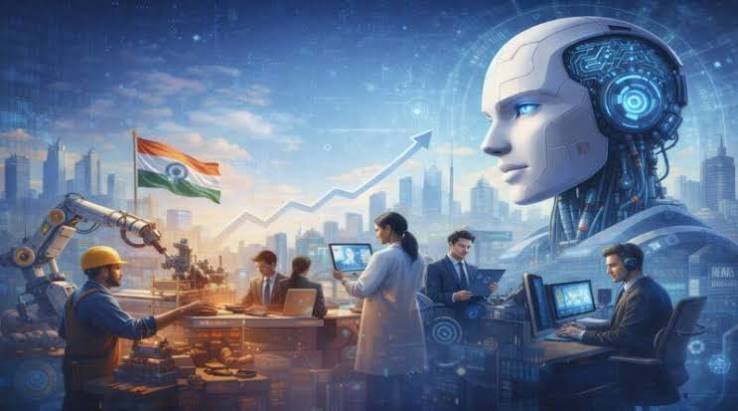
The simple answer is: some tasks will be automated, some jobs will change, and new opportunities will emerge.
It is much harder to predict that AI will simply eliminate entire professions.
The World Economic Forum’s research points toward a labour market where job creation and job displacement happen simultaneously.
The distinction between a job and a task is important.
Imagine a graphic designer who spends part of the day creating several basic variations of an image.
An AI tool may automate some of that repetitive work.
But the designer may still be needed to understand the client’s objective, choose a visual direction, communicate with the client and decide which result is actually useful.
The technology changes the workflow rather than necessarily eliminating the entire profession.
Why Entry-Level Workers May Face a Different Challenge
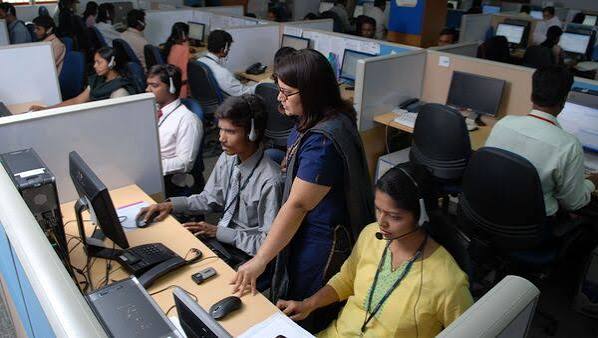
One of the most interesting issues surrounding AI is its potential effect on entry-level work.
Many fresh graduates traditionally begin their careers by handling relatively repetitive tasks.
These jobs help employees learn how businesses operate.
But if AI can perform some basic tasks faster, companies may need fewer people for certain entry-level activities.
Recent reporting has highlighted this concern, arguing that AI could affect the first step of the career ladder even if it does not produce widespread unemployment.
This creates a new challenge for students.
A degree may still be useful, but simply having a degree may not be enough.
Students increasingly need to demonstrate:
- practical skills
- problem-solving ability
- communication
- adaptability
- project experience
- and the ability to use modern tools effectively
The Most Important Skills for India’s AI Economy

There is no single skill that guarantees a job.
Instead, the strongest candidates are likely to combine technical skills with human skills.
1. Artificial Intelligence and Machine Learning
AI and machine learning remain among the fastest-growing technical skill areas.
Students interested in this field can start with fundamentals such as:
- Python
- statistics
- data structures
- machine learning concepts
- data analysis
- model evaluation
- and basic AI tools
However, learning AI does not mean immediately trying to build the next ChatGPT.
A strong foundation is more valuable than jumping between dozens of AI tools.
2. Data Analysis
Companies generate enormous amounts of data.
Someone still needs to understand what that data means.
Data skills can include:
- Excel
- SQL
- Python
- statistics
- data visualization
- and business analysis
The combination of data + domain knowledge can be particularly valuable.
For example, a person who understands both finance and data analysis may be more useful to a financial company than someone who only knows how to operate a generic AI tool.
3. Cybersecurity
As more business operations become digital, security becomes increasingly important.
Companies need professionals who understand how to protect:
- applications
- networks
- databases
- cloud systems
- identities
- and sensitive information
The World Economic Forum lists networks and cybersecurity among the fastest-growing skill areas through 2030.
This makes cybersecurity an interesting career direction for students who enjoy technology but don’t necessarily want to become AI researchers.
4. AI Literacy
Not everyone needs to become a machine-learning engineer.
But many professionals will benefit from understanding how AI systems work at a practical level.
AI literacy can include knowing:
- what generative AI can do
- where it makes mistakes
- how to write useful prompts
- how to verify AI-generated information
- how to protect confidential data
- and how to integrate AI into a workflow
The important difference is between using AI casually and using AI to solve a real problem.
5. Analytical Thinking
Technology skills are only part of the picture.
The World Economic Forum identifies analytical thinking as a major core skill for employers.
Why does this matter?
Because AI can generate an answer.
A professional still needs to decide:
Is the answer correct?
Does it solve the actual problem?
What information is missing?
What should happen next?
This is why people who can evaluate information critically may become increasingly valuable.
6. Creative Thinking
AI can generate text, images, code and ideas.
That doesn’t make human creativity irrelevant.
Instead, the definition of creativity may change.
A person who can identify an interesting problem, develop an original concept and combine different ideas can use AI as a productivity tool.
The World Economic Forum also lists creative thinking among the skills expected to increase in importance.
7. Communication
Good communication is often underestimated by technical students.
But companies still need people who can:
- explain ideas
- write clearly
- communicate with clients
- work in teams
- present information
- negotiate
- and understand other people’s requirements
An employee who knows AI but cannot explain the result to a team may be less useful than someone who can translate technical information into practical decisions.
8. Adaptability and Continuous Learning
Perhaps the most important skill is the ability to learn new skills.
AI tools are changing quickly.
A tool that is popular today may be replaced or significantly improved within a few years.
That means learning one particular software product is less valuable than learning how to learn.
The World Economic Forum identifies resilience, flexibility, agility, curiosity and lifelong learning among the skills expected to rise in importance.
AI Skills Alone May Not Be Enough
There is a common mistake among beginners:
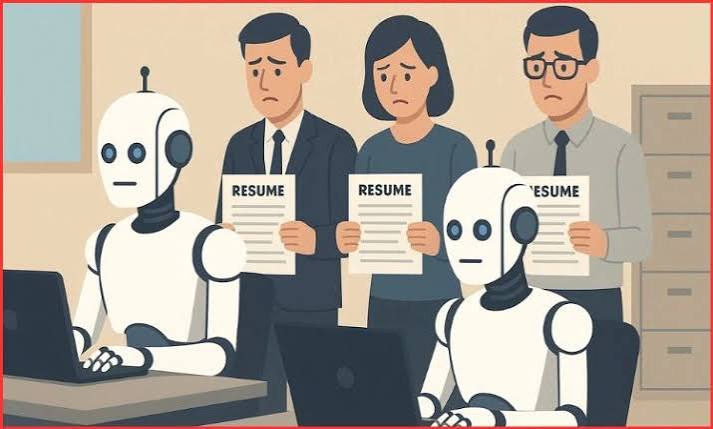
They collect AI certificates.
They learn ten different AI tools.
They write “AI expert” on their resume.
But they cannot demonstrate what they have actually built.
Employers increasingly need people who can create measurable results.
For example:
Instead of saying:
“I know ChatGPT.”
A stronger statement would be:
“I built a workflow that uses AI to classify customer queries and reduced the time required for manual sorting.”
The second statement demonstrates application.
That’s what students should focus on.
What Should Indian Students Learn?
There is no universal roadmap because career goals are different.
However, a practical approach could look like this.
For Computer Science Students
Focus on:
- Python
- Data Structures and Algorithms
- SQL
- Git
- APIs
- AI/ML fundamentals
- cloud basics
- cybersecurity fundamentals
Don’t abandon programming simply because AI can generate code.
Understanding code becomes even more important when you need to verify or modify AI-generated solutions.
For Commerce and Finance Students
Consider learning:
- Excel
- financial analysis
- SQL
- data visualization
- basic Python
- AI-assisted research
- financial modelling
Combining finance knowledge with technology can create a stronger professional profile.
For Marketing Students
Useful areas include:
- analytics
- SEO
- content strategy
- consumer research
- social-media analysis
- AI-assisted content workflows
- digital advertising
The goal shouldn’t be to produce unlimited AI-generated content.
It should be to use AI to improve research, analysis and productivity while maintaining human judgement.
For Non-Technical Students
You don’t necessarily need to become a programmer.
Start with:
- Basic digital literacy
- AI fundamentals
- Productivity tools
- Data interpretation
- Communication
- Problem-solving
- One specialised domain
A person who combines AI literacy with strong knowledge of a particular industry can have an advantage over someone who knows AI tools but understands no specific business problem.
Are Degrees Becoming Less Important?
Degrees are not suddenly becoming useless.
But the relationship between degrees and employment is changing.
The World Economic Forum reports that around 30% of companies operating in India expect skills-based hiring, including removing some degree requirements, to help them access emerging talent.
This does not mean students should stop going to college.
Instead, it means that education and demonstrable skills increasingly need to work together.
A degree can provide:
- foundational knowledge
- structured learning
- peer networks
- internships
- credibility
- and access to certain professions
Skills can demonstrate what you can actually do.
The strongest combination is often education + skills + projects + experience.
Build Projects Instead of Only Collecting Certificates
Suppose a student completes five online courses about AI.
That’s useful.
But imagine another student completes two courses and builds three projects:
- a customer-support chatbot
- a document summarization tool
- a sales-data dashboard
The second student has something concrete to demonstrate.
Projects help answer the question:
“What can you actually do?”
For freshers, this can be especially important because they don’t yet have years of professional experience.
What Could the Indian Job Market Look Like by 2030?
Nobody can predict the exact job market of 2030.
However, current research gives us some useful signals.
The World Economic Forum expects technology-related roles to grow rapidly while employers simultaneously place greater importance on human capabilities such as analytical thinking, creativity, resilience and leadership.
India’s situation is particularly interesting because companies are simultaneously adopting AI, robotics, digital technologies and other emerging technologies while facing a shortage of relevant skills.
That creates both a challenge and an opportunity.
The challenge is that workers who don’t update their skills may struggle as job requirements change.
The opportunity is that people who develop useful combinations of technical and human abilities can position themselves for emerging roles.
A Practical Skill Combination for 2030
Instead of trying to master everything, think in terms of a skill stack.
For example:
Software Developer
Programming + AI tools + system design + communication
Digital Marketer
Marketing + analytics + AI + creativity
Financial Analyst
Finance + Excel/SQL + data analysis + AI
Cybersecurity Professional
Networking + security + scripting + AI awareness
Content Creator
Storytelling + editing + analytics + AI tools
The exact combination will differ by career.
But the principle is the same:
Don’t compete with AI at the tasks AI performs best. Learn how to use AI while becoming better at the parts that require judgement, context and human understanding.
Final Thoughts
The future of work in India is unlikely to be a simple story of humans versus artificial intelligence.
It will be more complicated.
Some tasks will disappear.
Some jobs will change.
New roles will emerge.
And many existing professions will absorb AI into their everyday workflows.
For Indian students and professionals, the safest strategy is not to chase every new AI tool.
Instead, build a strong foundation in your chosen field and learn how AI can make you more effective in that field.
A programmer should understand programming.
A marketer should understand marketing.
A finance professional should understand finance.
A designer should understand design.
Then AI can become a powerful addition to that expertise.
The people most prepared for the next decade may not be those who know the most AI tools.
They may be the people who understand how to combine AI with valuable human skills to solve real problems.
Frequently Asked Questions
Will AI replace jobs in India by 2030?
AI is expected to automate some tasks and transform many jobs, but current research points to both job creation and job displacement rather than the complete disappearance of work. The World Economic Forum projects significant job creation alongside displacement through 2030.
Which AI skills should students learn?
AI fundamentals, data analysis, AI-assisted workflows, Python and machine-learning concepts can be useful for technical careers. For non-technical careers, AI literacy combined with domain expertise can be more practical than trying to become an AI engineer.
Is coding still worth learning because of AI?
Yes. AI can help generate code, but understanding programming remains important for designing systems, debugging, reviewing AI-generated code and solving problems that require technical judgement.
Which jobs are expected to grow in India?
The World Economic Forum identifies roles such as Big Data Specialists, AI and Machine Learning Specialists and Security Management Specialists among India’s fastest-growing job categories toward 2030.
Are soft skills still important in the AI era?
Yes. Analytical thinking, creative thinking, resilience, flexibility, leadership and collaboration remain important alongside technical skills.
Sources and Further Reading
- World Economic Forum — Future of Jobs Report 2025
- World Economic Forum — The Future of Jobs in India
- World Economic Forum — Skills Outlook
- Ashoka University — India’s Jobs in Transition: Skills, AI and the Future of Work
Tags: AI and jobs in India, AI and jobs in India, AI and jobs in India, AI and jobs in India